
EVA decking has a wide service temperature range. In most climates, the cold itself will not destroy it — a pad left outdoors through a hard winter usually comes back looking much the same.
What damages it is water. Water that gets under an edge, into a seam, or into a cut cell, then freezes, expands by roughly nine percent, and pries the bond apart a little further each cycle.
That single fact reorganises the whole winter checklist: the goal is not to keep the deck warm. It is to keep it dry, ventilated, and free of standing water for four months.
Freeze-thaw at the edges. A lifted edge or a poorly sealed perimeter lets water in. Overnight it freezes; by afternoon it thaws. Ten or twenty cycles later, the edge is up 15 mm and the fix is no longer cosmetic.
Moisture trapped under a cover. A non-breathable tarp laid directly on the deck traps condensation against the surface. Four months of that produces mildew, chalky bloom, and a smell that does not come out with a single wash.
Point loads that never relax. A snow shovel left on the pad, a battery box, a trailer strap pulled tight across a panel. EVA is closed-cell, but sustained compression at low temperature leaves a set that recovers slowly — or not at all.
Cold embrittlement of the foam itself is rarely the issue. Cold does, however, make the adhesive more brittle in peel, which is exactly why an edge with water behind it fails in winter and not in summer.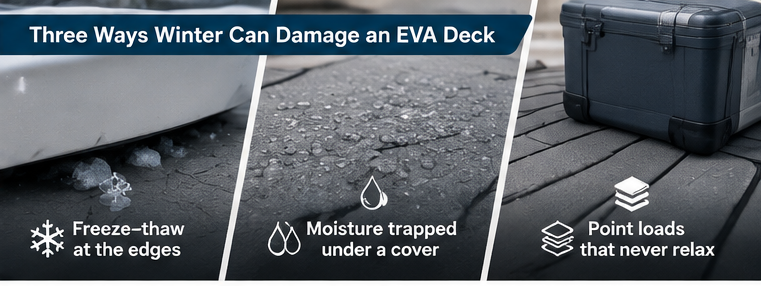
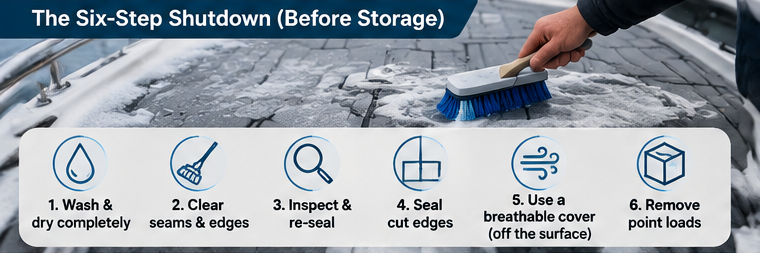
Do this before the boat is put away, not after the first freeze.
Indoors, heated. Almost nothing to do beyond cleaning and a visual check. This is the easiest winter a deck will ever have.
Indoors, unheated. Ventilation matters more than temperature. Condensation on a cold deck under a tight cover is the same problem as outdoors, just less severe.
Outdoors on a trailer. Watch the straps. A ratchet strap tightened across a panel for months is a compression set waiting to happen — route straps around the hull, not over the deck.
Outdoors in the water or on a lift. Ice is the risk: moving ice at the waterline abrades anything it touches. If the marina freezes, the deck is the least of the problems — but check the swim platform and any low edge after thaw.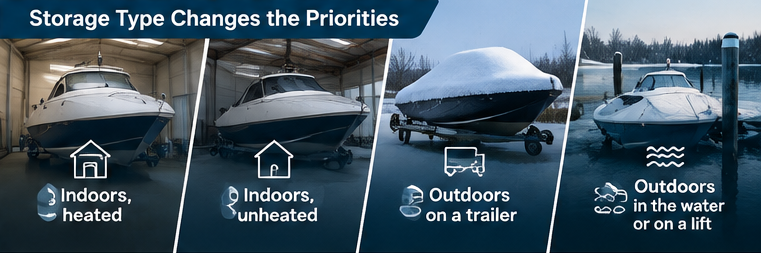
Snow: clear it with a soft broom or a plastic shovel with a rounded edge. Do not let it sit and refreeze into ice; ice is what does the damage, not snow.
Ice: never chip at it with a metal tool, and never pour hot water on it. Hot water on a cold pad is a thermal shock to the coating and puts meltwater exactly where you do not want it — into the seams, where it will refreeze overnight.
Salt: avoid it. De-icing salts are hygroscopic — they pull moisture out of the air and hold it against the deck and against every fastener and fitting nearby. The residue also attacks the adhesive interface over time. If salt has been used, rinse thoroughly in spring, not in winter.
A winter article needs one blunt warning: bonding below roughly 10 °C does not work properly, and a bond made cold may never reach full strength even after the boat warms up.
If a customer wants a deck fitted in an unheated shed in January, the honest answer is to wait. A heated space with the substrate at 18–25 °C is the only reliable winter installation.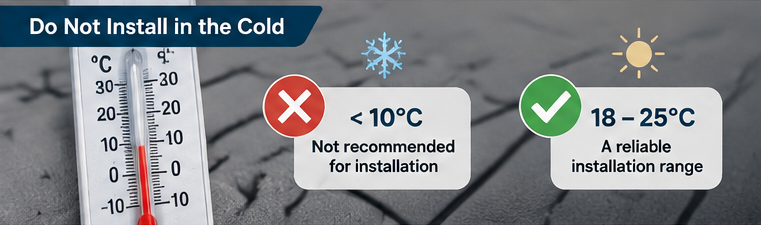
| Mistake | Consequence |
|---|---|
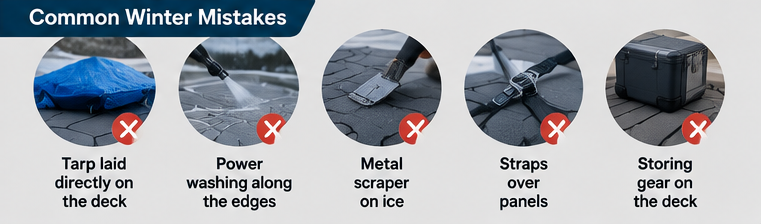
| Tarp laid directly on the deck | Condensation, mildew, bloom |
| Sealing the cover tight with no vents | Same, worse |
| Power washing along the edges | Sealed perimeter broken, water ingress |
| Hot water to melt ice | Coating shock, meltwater into seams |
| Metal scraper on ice | Cut cells, permanent marks |
| Salt or calcium chloride | Hygroscopic residue, corrosion, adhesive attack |
| Storing gear on the deck | Compression set that will not fully recover |
| Straps over panels | Local crushing and edge lift |
| Installing below 10 °C | Bond that never reaches full strength |
The foam handles deep cold well; it stays flexible far below freezing. The vulnerable parts are the top coat and the adhesive interface. Damage almost always comes from water freezing behind an edge, not from temperature alone.
Yes, if the cover breathes and does not touch the deck. A frame plus vents is the difference between protection and a condensation chamber.
Remove it. Snow is harmless until it melts and refreezes into ice, and until its weight sits on the pad for weeks.
Usually not. It is typically mineral residue or light surface oxidation and comes off with a neutral cleaner. If it does not, and the surface feels chalky, the top coat has aged and that is a different conversation.
Yes, at low pressure and never directly at a seam or edge. High pressure at the perimeter is one of the most common ways a good deck starts taking on water.
No. Check the perimeter each spring and re-seal only where it has opened. Annual re-sealing of sound edges adds nothing.
Winter is not a test of the foam. It is a test of the edges, the seams, and whoever covered the boat.
Keep it dry, keep air moving, keep weight off it — and the deck that goes into storage in November will come out in April as the same deck, not a repair job.
📧 Email: admin@marinedeckfactory.com
📱 Cel: +86-13699812532
🏭 Address:
Ruiji Industry Zone, Dongao Village,
Shatian Town, Huiyang District,
Huizhou City, Guangdong Province, China.
🌐 Website: marinedeckfactory.com
Send us your inquiry now and get free samples for testing.
Contact Us Now →


